
KeyPoints
No law says you must have a survey before building a boundary fence, but a dividing fence should generally sit on the boundary, so you need to know where that is.
If the pegs are missing, or you and your neighbour disagree about the line, a boundary re-establishment survey is the safest way to find it.
NSW and Victoria have different fencing laws, but in both states neighbours generally share the cost of a sufficient dividing fence, and surveying can be one of the shared costs.
Only a registered (NSW) or licensed (Victoria) surveyor can legally define a boundary. A fencing contractor cannot.
Summary
You do not need a survey by law before building a boundary fence, but you do need to know where the boundary is. If the pegs are missing or the line is in doubt, a boundary re-establishment survey gives you a clear answer before any posts go in. This article explains when a survey is worth it, what it involves, and how fencing notices and cost sharing work in NSW and Victoria.
Outline
You have decided to replace the old fence or put up a new one. Before the fencer arrives, one question tends to come up: where exactly is the boundary? It is a more important question than it might seem, and getting it wrong can be a costly mistake.
The short answer is that no law says you must have a survey first. But a fence built in the wrong spot can end up on your neighbour’s land, and that can lead to disputes, delays, and the expense of moving it. In this article, we explain when a survey is worth it, what it involves, and how fencing rules work in NSW and Victoria.
Is a Survey Required Before You Build a Boundary Fence?
Neither NSW nor Victoria requires a survey before you build a boundary fence. What matters is that a dividing fence should generally sit on the boundary, so the real question is whether you actually know where that boundary is.
Many people assume they do. They go by an existing fence, a driveway edge, or an old peg. But a fence that has stood for years is not proof of where the legal boundary sits. Fences are often built for convenience, or based on what past neighbours agreed, rather than from an accurate survey. Our guide to boundary surveys explains why this matters.
The rules for fencing differ between the two states, so here is a short summary of each. Please note this is general information only, not legal advice.
Boundary Fence Rules in NSW
In NSW, a dividing fence normally goes on the common boundary. Neighbours generally share the cost of a sufficient dividing fence, whether one is being built where there was none before, or an existing fence needs to be repaired or replaced.
Any agreement should be put in writing. If you and your neighbour cannot agree, either party can serve a Fencing Notice. If there is still no resolution after around a month, either neighbour can apply to the Local Court or NCAT for Fencing Orders.
If the boundary itself is unclear, the fence is usually placed as close to it as possible and the agreed location recorded in writing. If agreement on the boundary location still cannot be reached, either party can serve a Boundary Notice. Legal Aid NSW explains the full steps.
Boundary Fence Rules in Victoria
In Victoria, fencing is governed by the Fences Act 1968. A dividing fence is joint property and should generally sit on the boundary line, with costs shared equally between neighbours. The law requires a “sufficient dividing fence” but does not prescribe a fixed height or material.
A Fencing Notice sets out your plan to build, repair, or replace a fence, and your neighbour has 30 days from receiving it to respond. Serving a notice is not mandatory, but without one it becomes much harder to demonstrate that both parties were in agreement.
Victoria’s Department of Justice also notes that only practising licensed surveyors can carry out boundary surveys. You can read more on its fencing law page..
When a Survey Is Worth It (and When You Can Skip It)
A survey is worth organising any time there is genuine doubt about where the boundary sits. Common situations where it pays to get one include:
There are no visible boundary pegs, or you are not confident the ones you can see are correctly placed.
The new fence will go in a different position to the old one.
You and your neighbour disagree about where the boundary line falls.
The boundary is long, such as on a rural property, where a small discrepancy at one end can become a significant gap at the other.
The property is being prepared for sale and you want the fence position to be accurate.
You may not need a survey if you are replacing a fence on the same line, the boundary is not in doubt, and your neighbour is in agreement. If you are at all unsure, a survey is the safest and most straightforward way to get a clear answer before work begins.
It is also worth keeping in mind that a fencing contractor builds where you ask them to build. Working out where the legal boundary actually sits is a surveyor’s job, and in both NSW and Victoria, that can only be done by a registered or licensed surveyor.
What a Boundary Survey for a Fence Involves
A boundary re-establishment survey follows a clear and consistent process. Here is what to expect at each step.
Title and plan research. We start by reviewing your Certificate of Title, deposited plans, and any earlier survey records relevant to the property.
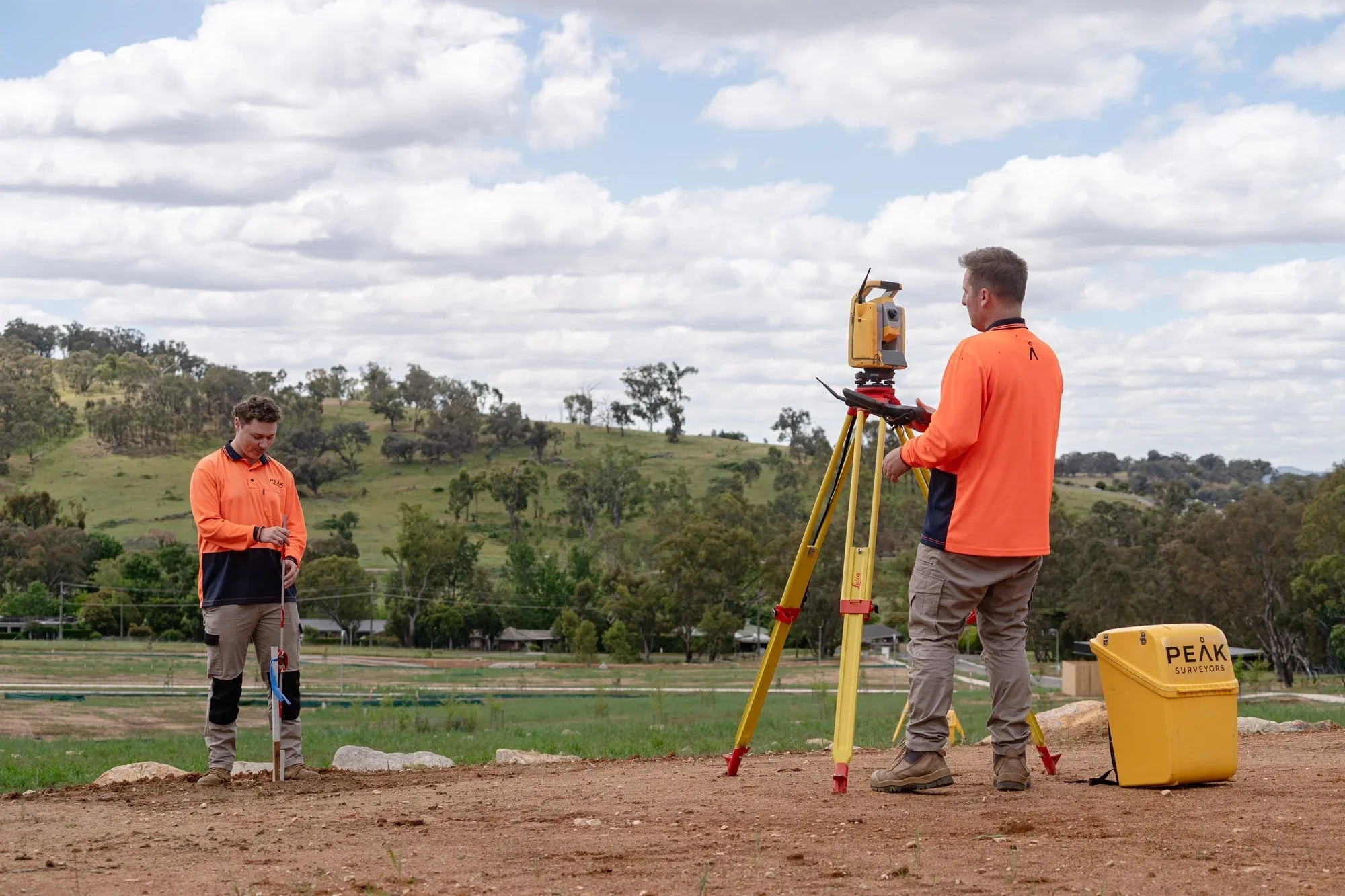
Field survey. Our surveyors visit the property, locate existing survey marks, and measure from known reference points to build an accurate picture of the boundary.
Boundary determination. We combine the field evidence with the title records to establish where the boundary legally sits.
Marking and plan. Where needed, boundary marks are placed or confirmed on the ground, and a plan is prepared showing the result clearly.
A few things can help the day go smoothly:
Gather your title documents, any plans, and any earlier survey papers you have access to.
Clear the areas along the fence line so the surveyor can reach the boundary without obstruction.
Let your neighbour know the surveyor is coming.
Once the boundary is marked, you and your neighbour can agree on the fence position with confidence, and your fencer can build directly to the marks.
Doing It Right With Your Neighbour: Notice, Agreement and Sharing Costs
A survey is only one part of fencing well. How you approach things with your neighbour matters just as much. A little preparation and clear communication can go a long way toward keeping the process straightforward.
Talk first. Most fencing matters are resolved with a straightforward conversation. Put whatever you agree in writing, including where the fence will go and how costs will be shared.
Use a notice if you need one. In NSW, a Fencing Notice is the formal step when agreement cannot be reached. In Victoria, a Fencing Notice gives your neighbour 30 days to respond to your plans.
Know who pays. In both states, costs are generally shared between neighbours. Surveying can be one of those shared costs. If one neighbour wants a more expensive fence than what is considered sufficient, they generally cover the difference.
Know where disputes go. In NSW, the Local Court or NCAT can issue Fencing Orders. In Victoria, the Dispute Settlement Centre of Victoria offers advice and dispute resolution services.
Before work begins, it is also worth checking a few additional things:
Council requirements around fence height and materials.
Any covenants or easements registered on your title.
Where underground services are located. In NSW, Legal Aid recommends lodging a Before You Dig Australia enquiry before any digging starts.
Get Your Boundary Pegged Before the Fence Goes In
At Peak Surveyors, we are a fully licensed and registered surveying practice working across NSW and Victoria. As experienced boundary surveyors and one of the trusted land surveyors in the Albury Wodonga region, we mark your boundary accurately so the fence goes in the right place the first time.
We work across Albury, Wodonga, Wangaratta, Bright, Wagga Wagga, and the surrounding region. If you are planning a fence and want certainty about your boundary before work starts, get in touch with our team. You can also read more about our title boundary and cadastral survey services.
FAQs About Boundary Fences and Surveys
-
Generally, yes. In both NSW and Victoria, a dividing fence normally sits on the common boundary. It is a good idea to agree the position with your neighbour in writing before work begins, and to check council rules, any covenants, and easements on your title first.
-
Neighbours in NSW generally share the cost of a sufficient dividing fence. Any agreement should be recorded in writing. If agreement cannot be reached, either neighbour can serve a Fencing Notice, and after around a month either party can apply to the Local Court or NCAT for a resolution. For the full process, see Legal Aid NSW. This is general information only and not legal advice.
-
In both NSW and Victoria, surveying can be one of the costs that neighbours share when building a dividing fence. The outcome will depend on the circumstances and what both parties agree to, so it is worth having that conversation early.
-
“Survey” covers a wide range of work. A boundary survey establishes where your legal boundaries sit. A feature and level survey, also known as a topographic survey, maps what exists on the land, such as slopes, buildings, and services. For fencing purposes, a boundary survey is what you need.